Numath Projects

ROSAS

RObust simulation Systems exploiting Artificial Intelligence based turbulence models and high-fidelity algorithmS

Funded by the European Union. Views and opinions expressed are however those of the author(s) only and do not necessarily reflect those of the European Union or the European Climate, Infrastructure and Environment Executive Agency (CINEA). Neither the European Union nor the granting authority can be held responsible for them. Grant Agreement n°101138319

Funded by European Union

What is ROSAS

RObust simulation Systems exploiting Artificial Intelligence based turbulence models and high-fidelity algorithmS

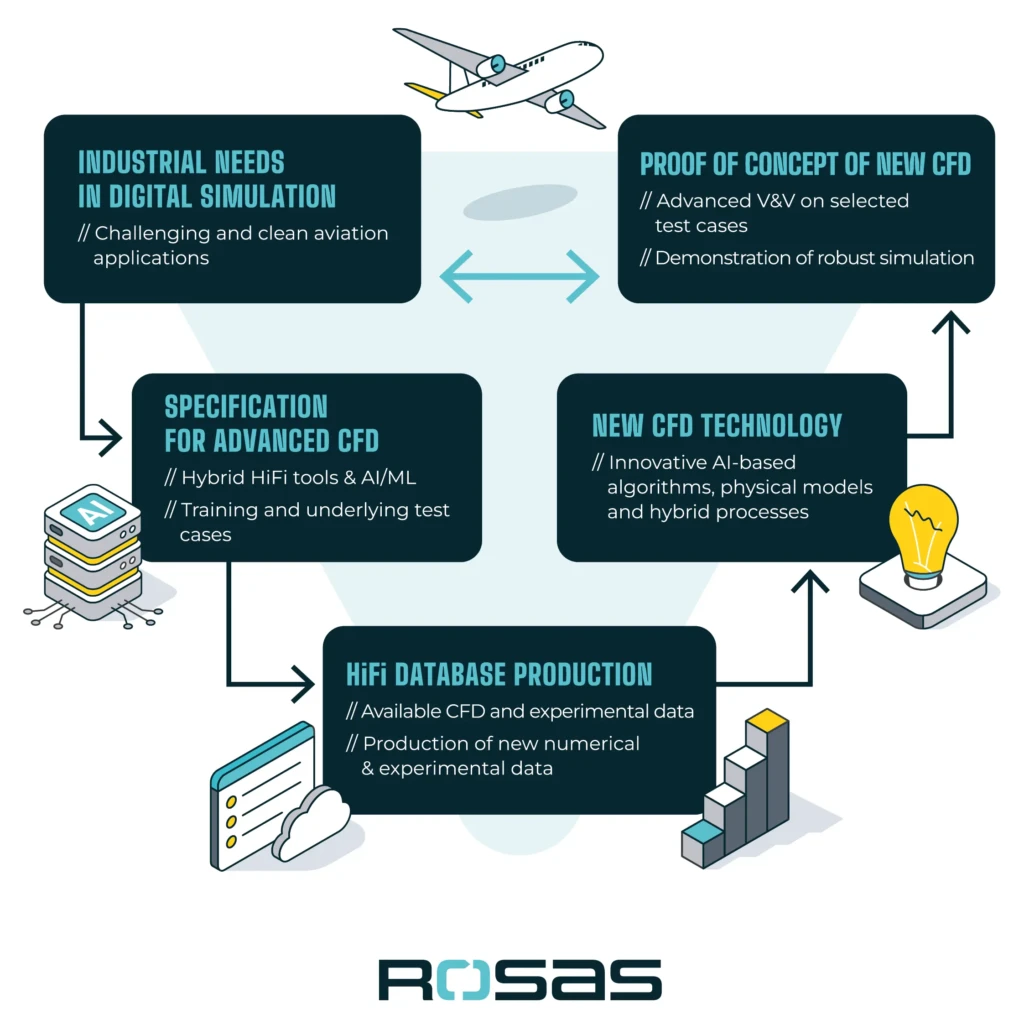
ROSAS is a European Project dedicated to develop AI-augmented aerodynamic simulation tools to accelerate aircraft design and reduce costly physical testing.
To meet the European Union’s goals of aeronautical industry competitiveness and climate neutrality, ROSAS is developing AI-advanced Computational Fluid Dynamics (CFD) algorithms, key innovation in the rapid growth of digital transformation for design in aerospace industry. Traditional CFD processes require multiple costly and incremental refinements. By integrating Machine Learning algorithms trained on high-fidelity simulations and experimental data, ROSAS will provide an innovative computational framework for faster and more precise evaluations of next-generation aircraft configurations.
This project represents a key step in enabling the next generation of climate-neutral aircraft with improved operational reliability.

Challenges

ROSAS’s two main scientific and technical challenges

AI-driven high-order algorithms

Developing advanced AI methodologies and high-order numerical algorithms to optimize computational performance and align with next-generation High-Performance Computing (HPC) infrastructure.

ML-based turbulence modelling

Creating Machine Learning-driven turbulence models using statistical data and time-series results from high-fidelity simulations and experiments, improving the accuracy of complex aerodynamic predictions. By addressing these challenges, ROSAS will help bridge the gap between academic research and industrial applications, ensuring that AI-augmented simulation tools become a fundamental component of future aircraft design strategies


Implementation

Context